Why the Moon Looks Bigger on the Horizon
The rising Moon looks enormous, then shrinks overhead. The Moon has not changed — the brain's size estimate has.
Why the Moon Looks Bigger on the Horizon
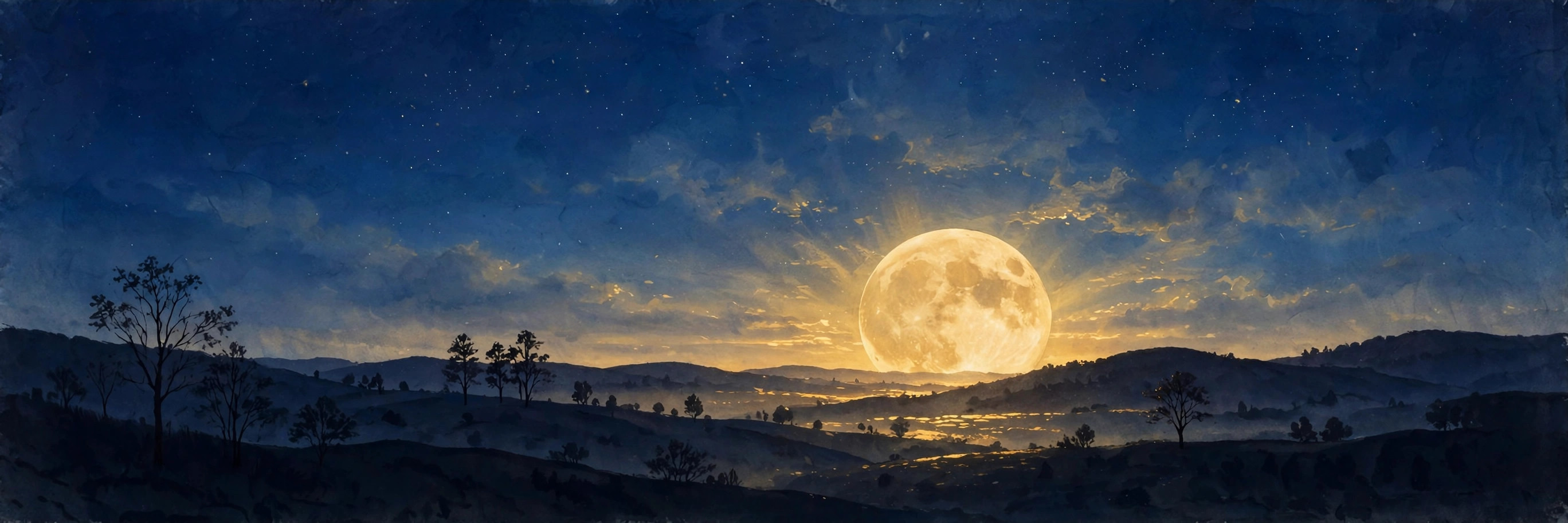
On a clear evening, the Moon can look enormous as it rises. Hours later, high in the sky, the same Moon looks ordinary, almost small. It is a striking effect, and it is almost entirely in your head.
First, rule out the atmosphere
A common explanation is that the atmosphere magnifies the low Moon, like a lens. It is a neat idea, and it is wrong. The atmosphere does bend light, which is why the Sun and Moon can look slightly flattened near the horizon, but it does not make them larger. If anything, the effect is the opposite.
You can test this without any equipment. Hold a thumb at arm's length next to the rising Moon, then do the same when the Moon is high. It covers about the same amount of thumb either way. A camera tells the same story: photographed with the same lens, the Moon is essentially the same size in both positions.
In fact, the Moon's apparent size is about half a degree across, roughly the width of a thumbnail at arm's length. That changes a little over the month, because the Moon's orbit is elliptical and it is sometimes nearer and sometimes farther, but that change has nothing to do with how high it is in the sky on a given night.
So why does it look bigger?
The leading explanation is about how the brain judges size. When the Moon sits near the horizon, it is surrounded by things the brain knows how to scale: trees, hills, houses, fields stretching away. Those cues make the sky near the horizon feel far away, like a flattened dome rather than a perfect sphere. The brain, reasoning that an object that far away must be large to look that big, inflates it.
High overhead, there are no such cues. The Moon hangs in empty sky, with nothing to compare it to, and the brain settles for a smaller estimate.
A related effect, sometimes called the Ponzo illusion, shows the same trick in miniature. Two identical lines placed over a drawing of converging railway tracks look different in size, because the brain reads depth cues into a flat picture and adjusts accordingly. The horizon Moon is, in a sense, a Ponzo illusion played out across the whole sky.
A simple way to break the spell
If you want to watch the illusion collapse, try looking at the rising Moon upside down, between your legs, or through a cardboard tube that hides the horizon. Without the landscape cues, the Moon suddenly shrinks back to its ordinary size. It is a strange, almost disappointing moment, and a useful reminder of how much of seeing is guessing.
The Moon has not changed. The sky has not changed. Only the context has changed, and the brain, faced with the same disc in a different setting, tells a different story about it.
That is what makes the effect worth noticing. It is not a trick of astronomy. It is a small, nightly demonstration that perception is not a photograph. It is an interpretation, built from cues, distance, and expectation, and sometimes the interpretation is more interesting than the thing itself.